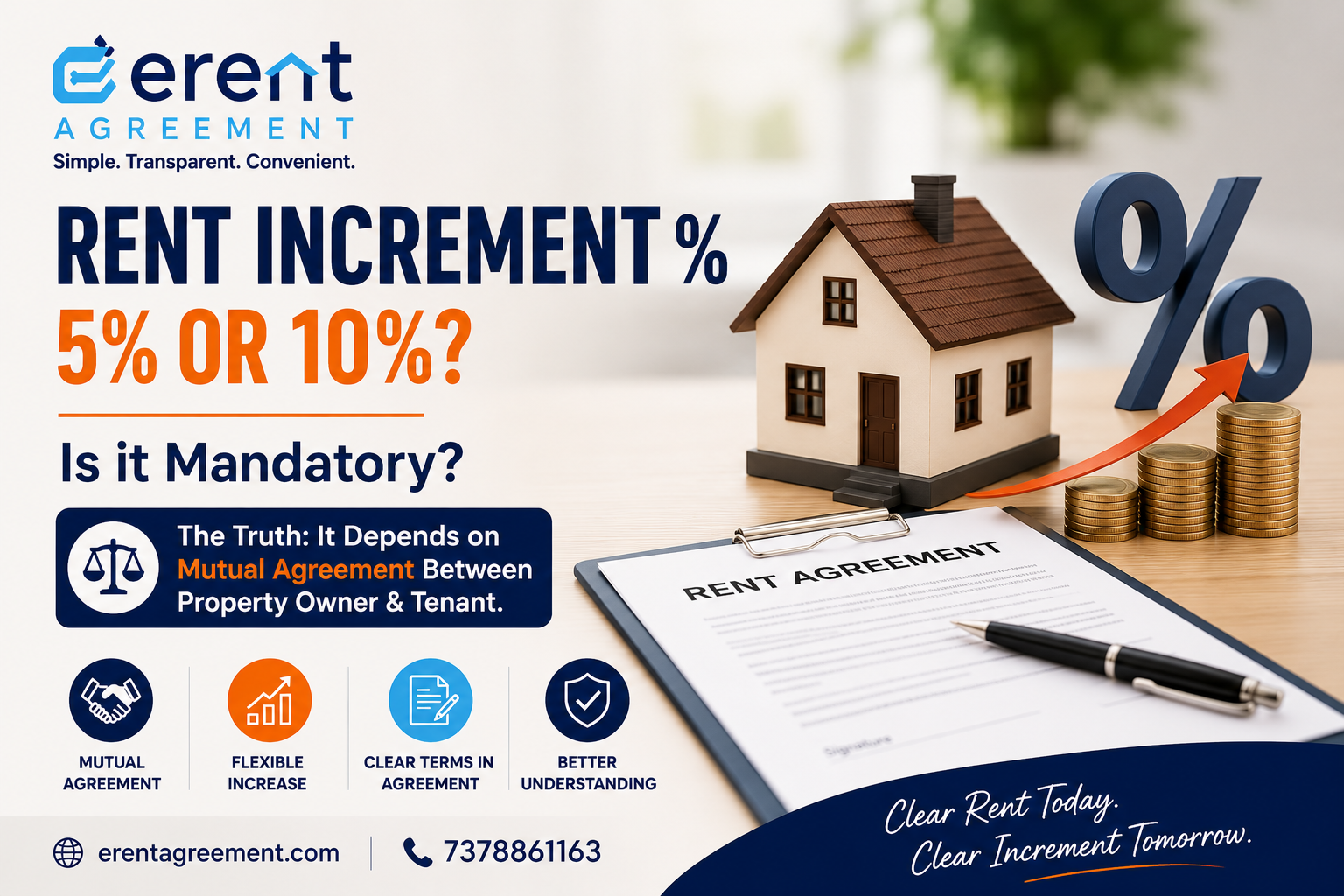
How Much Should Rent Increase Every Year?
One of the most common questions Property Owners and Tenants ask while preparing a Rent Agreement is:
“How much should the rent increase after one year?”
Should it be 5%?
Should it be 10%?
Is 10% the maximum limit?
Is a yearly rent increase compulsory?
Can the Property Owner increase the rent by any percentage?
The simple answer is:
There is no universal fixed percentage that applies to every rental arrangement.
In many private rental transactions, the rent increment is decided based on the mutual agreement between the Property Owner and Tenant, subject to applicable laws and the terms of the agreement.
In practice, increases such as 5% to 10% are commonly discussed.
But that does not automatically mean:
❌ 5% is compulsory.
❌ 10% is mandatory.
❌ 10% is always the maximum permitted increase.
The agreed rent increment depends on the rental transaction, property, location, market conditions, negotiations, and mutually accepted terms.
Why Do People Think Rent Must Increase by 10%?
This is a very common misunderstanding.
Many Property Owners say:
“The rent has to increase by 10% every year.”
Some Tenants believe:
“The Owner cannot increase the rent by more than 10%.”
But in ordinary private rental negotiations, parties often decide the escalation terms themselves, subject to applicable legal requirements.
The 10% figure has become popular because it is frequently used in rental negotiations and agreements.
Over time, a common market practice can start sounding like a compulsory legal rule.
But these are two different things.
Common practice does not automatically mean a universal legal requirement.
Is a 5% Rent Increment Mandatory?
Not as a universal rule for every rental transaction.
A 5% increase is commonly used because some Property Owners and Tenants consider it a reasonable escalation.
For example:
Current Monthly Rent: ₹20,000
Agreed Annual Increment: 5%
Calculation:
₹20,000 × 5% = ₹1,000
Therefore, the revised monthly rent would be:
₹21,000 per month
If both parties agree to this arrangement and clearly record it in the Rent Agreement, the terms become clear from the beginning.
Is a 10% Rent Increment Mandatory?
Again, there is no universal rule requiring every private Rent Agreement to have a 10% annual increment.
However, 10% is another commonly negotiated figure.
For example:
Current Monthly Rent: ₹20,000
Agreed Increment: 10%
Calculation:
₹20,000 × 10% = ₹2,000
The revised monthly rent would therefore be:
₹22,000 per month
The important point is that the percentage should be discussed and mutually agreed upon.
Can the Rent Increment Be Less Than 5%?
Depending on the applicable law and mutual agreement between the parties, the Owner and Tenant may negotiate a different escalation arrangement.
For example:
The Property Owner may be satisfied with a good long-term Tenant and agree to a smaller increase.
The Tenant may maintain the property properly and consistently pay rent on time.
The Owner may prefer stability rather than searching for a new Tenant every year.
In such circumstances, the parties may negotiate an increment that suits their rental arrangement.
Can There Be No Rent Increment?
This is another interesting question.
Suppose the Property Owner and Tenant enter into a longer-duration Rent Agreement.
Can they agree to keep the same rent for the agreed period?
The appropriate arrangement depends on the applicable law and the mutually accepted contractual terms.
For example, the parties may agree:
“The monthly rent shall remain unchanged for the entire agreement tenure.”
Alternatively, they may agree to an escalation after a specified period.
The important thing is clarity.
Can the Rent Increase After 11 Months?
Yes, the parties can negotiate a rent revision when entering into a fresh or renewed rental arrangement.
For example:
First Agreement:
Monthly Rent: ₹25,000
Duration: 11 Months
At the end of the agreement, the Property Owner and Tenant discuss the new terms.
They mutually agree to increase the rent by 7%.
Calculation:
₹25,000 × 7% = ₹1,750
New Monthly Rent:
₹26,750
There is nothing unusual about agreeing to a percentage other than 5% or 10%, provided the arrangement complies with applicable law and is mutually accepted.
The Rent Increment Can Be Negotiated as Part of the Overall Deal
Rent should not always be viewed as an isolated figure.
Rental negotiations can involve several factors:
💰 Monthly Rent
🔐 Security Deposit
📅 Agreement Duration
📈 Rent Increment
📢 Notice Period
🔒 Lock-in Period
🏢 Maintenance Charges
🛠️ Repair Responsibilities
📄 Rent Agreement Expenses
For example, a Property Owner may say:
“I can reduce the initial monthly rent, but I would prefer a higher increment after 12 months.”
The Tenant may agree.
Or the Tenant may say:
“I can accept the proposed rent, but I would prefer a lower increment for the next two years.”
The Owner may agree.
Example 2: 10% Rent Increment
Suppose the monthly rent is ₹25,000.
The Owner and Tenant mutually agree to a 10% increase after the agreed period.
Initial Rent
₹25,000
Increase
₹2,500
Revised Rent
₹27,500 per month
Again, this is an agreed contractual term—not simply something that should be assumed.
Example 3: 7% Rent Increment
Who says the increment must always be 5% or 10%?
Suppose both parties agree to 7%.
Current Rent: ₹40,000
Increment: 7%
₹40,000 × 7% = ₹2,800
Revised Rent: ₹42,800
If both parties agree to the terms and they comply with applicable requirements, the agreed percentage can be clearly recorded in the Rent Agreement.
Example 4: Different Rent for Different Periods
In a longer agreement, the parties may agree on predetermined rent amounts.
For example:
Agreement Period
Monthly Rent
Months 1–12
₹30,000
Months 13–24
₹32,000
Months 25–36
₹34,500
In such a situation, there may not even be a need to describe the arrangement only as a fixed percentage increase.
The parties have already agreed on the rent payable during each period.
What Factors Can Influence Rent Increment?
There is no single percentage suitable for every property.
The negotiated increase may depend on factors such as:
1. Location
Rental demand varies significantly between cities and neighbourhoods.
2. Market Rent
If similar properties in the area are being rented at significantly higher prices, the Property Owner may seek a higher revision.
3. Quality of the Tenant
A Property Owner may value a Tenant who:
✅ Pays rent on time
✅ Maintains the property properly
✅ Follows society rules
✅ Communicates clearly
✅ Intends to stay for a longer period
In some cases, retaining a reliable Tenant may be more important to the Owner than seeking the highest possible rent increase.
4. Agreement Duration
A longer-term arrangement may involve predetermined rent escalation.
For example:
5% increase after every 12 months.
Or:
10% increase after every 24 months.
The parties can discuss a structure that suits their requirements, subject to applicable law.
5. Property Condition and Amenities
The rent negotiation may also consider:
🏠 Property condition
🛋️ Furniture
❄️ Air conditioning
🚗 Parking
🏊 Society amenities
📍 Location advantages
🔧 Improvements made to the property
Why Should the Rent Increment Be Mentioned in the Agreement?
This is extremely important.
Imagine the Owner believes:
“The rent will increase by 10% next year.”
But the Tenant believes:
“We agreed to only a 5% increase.”
After one year, a disagreement begins.
Who is correct?
Without clear documentation, resolving such misunderstandings can become difficult.
A properly drafted Rent Agreement should clearly record the agreed rent structure.
What Can a Rent Increment Clause Look Like?
Depending on the actual arrangement between the parties, a clause may state:
“The monthly licence fee shall be increased by 5% after completion of every 12 months during the tenure of this Agreement.”
Or:
“The monthly licence fee payable for the first 12 months shall be ₹30,000 and for the subsequent 12 months shall be ₹33,000.”
The wording should accurately reflect the actual agreement between the parties.
A Common Mistake: Discussing Rent Increment Only at Renewal
Many Property Owners and Tenants discuss:
💰 Current Rent
🔐 Deposit
📅 Agreement Duration
But forget to discuss:
📈 Future Rent Increment
Then, when the agreement is about to expire, disagreements begin.
The Owner expects a 10% increase.
The Tenant expects 5%.
Neither party remembers exactly what was discussed months earlier.
The better approach is to discuss future rent escalation before signing the agreement.
What Should Property Owners Do?
Before finalizing the Rent Agreement:
✅ Decide whether there will be a rent increment.
✅ Discuss the percentage or revised rent amount.
✅ Decide when the increase will apply.
✅ Clearly record the agreed terms.
✅ Ensure the Tenant understands the clause before signing.
What Should Tenants Do?
Before signing:
✅ Check whether the agreement contains a rent increment clause.
✅ Understand when the increase becomes applicable.
✅ Check how the revised rent will be calculated.
✅ Ask questions before approving the draft.
✅ Do not assume that the rent will automatically remain unchanged.
Is 5% Better or Is 10% Better?
There is no universal answer.
For one property, 5% may be mutually acceptable.
For another, the parties may agree to 7%.
In another transaction, they may agree to 10%.
Some parties may decide on fixed rent slabs instead of percentage-based increases.
The best rent increment is the one that is clearly discussed, mutually accepted, properly documented, and compliant with applicable law.
Mutual Agreement Is the Key
The biggest takeaway is simple:
There is no universal rule that every Rent Agreement must have exactly a 5% or 10% rent increment.
These percentages are commonly seen in rental transactions, but the actual arrangement depends on the mutual understanding between the Property Owner and Tenant, subject to applicable laws.
So, before signing your Rent Agreement:
💬 Discuss the rent.
📈 Discuss future increments.
📅 Decide when the increase applies.
📝 Put the agreed terms in writing.
At erentagreement, we believe that a good Rent Agreement should clearly reflect the actual understanding between the Property Owner and Tenant.
Our services include:
📄 Registered Rent Agreement Assistance
🚪 Doorstep Biometric Service
🌍 Service Reach Across 126+ Cities in India
📍 Assistance When Parties Are in Different Locations
📱 Real-Time Application Status Tracker
📩 SMS Updates at Every Stage
💰 Transparent Pricing
🎁 FREE Legal Consultation Worth ₹599 During Agreement Tenure*
Final Thoughts
So, how much should the rent increase every year?
5%?
7%?
10%?
The answer depends on the mutually agreed rental arrangement and applicable legal requirements.
5% is not a universal mandatory minimum.
10% is not a universal mandatory figure.
And there is no single percentage suitable for every rental transaction.
Property Owners and Tenants should discuss the rent increment during the initial negotiation and clearly record the agreed terms in the Rent Agreement.
Because disagreements often begin when one party says:
“I thought the increment was 5%.”
And the other says:
“I thought we agreed to 10%.”
Don’t Assume the Rent Increment. Discuss It. Decide It. Document It.
🌐 erentagreement.com
📞 7378861163
🏠 Clear Rent Today. Clear Increment Tomorrow. Better Understanding Throughout the Tenancy.

 +91-7378861163
  info@erentagreement.com
  8:00AM - 9:00PM